The Scientific Illusion of Facts, Information and Data
One of the most prevailing illusions we consistently maintain is that there is such a thing as scientific facts, where something is always true for every person and in every situation. Even with what modern science now knows about the true nature of reality being shaped by the mind of the person observing it, they still try to maintain the idea that some people’s perception is more accurate or true than others. But in the most basic sense, all ideas are archetypal in nature. There’s no such thing as a finite factual idea that’s true for everyone or that works the same way no matter how it’s adapted and applied. The mind of every individual perceives the same thing in a way that’s unique to everyone else. Our mind, which is comprised basically of two complementary aspects called the conscious and subconscious mind, is what orders and organizes all the information inherent in the atmosphere around us into a crystalline structure that corresponds with our mental model. Knowledge, in the most basic sense, is alive and in a constant state of evolving, it’s not dead or fixed.
Reality itself, in the most basic sense, is formed as a mental projection, where the same group of neutral information is shaped into a particular idea that matches the belief and knowledge base of the person perceiving it. While we can safely assume there is such a thing as an objective reality, where everyone sees the same basic elements and objects, such as a tree, house, flower, or bird, everyone will perceive and experience it in a different way from everyone else. All material forms and what we tend to generically refer to as information are, in essence, archetypal in nature, but we’ve lost an understanding of this somewhere along the way in our fundamental development. All reality is subjective in nature, where a universal idea, such as a tree, house, flower, or bird, are archetypes which can be shaped into an infinite number of variations for the same idea. So, we’re all seeing the same bird, while shaping our own experience of the bird as a unique possibility. There are only constant variations of and for the same idea, modified into a unique possibility through a natural process of adaptation, represented by the Dyad. Whatever we combine an idea with (our mental model), modifies it into a new possibility for the same overall idea. We are always creating how we experience the world around us.
All archetypal ideas serve as a universal (generalized) prototype for producing an endless number of possibilities for the same idea, and by molding it into an individual’s mental model, which is always unique to them because they created it, as a means of comprehending it, modifies all the attributes, properties and characteristics, reformulating it to produce a unique variation that reflects their own beliefs, preferences, knowledge base, and attitude. This is the only true fact that is primordial and remains the same across multiple dimensions, because it’s based on universal law. Our perception of reality is our own creation, formed as a mental projection, where we shape how reality appears to us. Anything that doesn’t match our mental paradigm or that can’t be described and explained using our paradigm, we can’t comprehend, and even when someone else tries to point it out and explain it to us, we can’t understand it. We literally can’t see it, and usually it doesn’t make any sense to us.
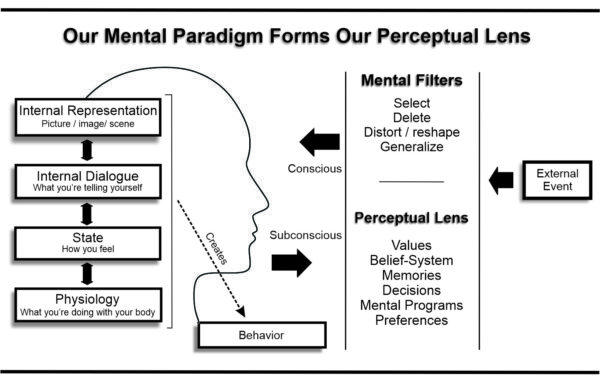
This idea is described in esoteric sciences as each one of us shaping how reality “appears” to us, and all transformation, which is an internal process, only works to change how the outer world appears to us. In many other spiritual traditions reality is referred to as “maya”, which means illusion. Reality is an illusion produced through our own perception, and everyone is subject to their own self-produced illusions. Change your inner state or grow your mental paradigm, and your perception of the outer world changes accordingly. Quantum physics, which I consider the modern version of spiritual sciences, has demonstrated that what we call a material object or physical reality exists initially in an unordered and unorganized state (chaotic) as a waveform, and is only collapsed into a single possibility as an organized field of light by the mind of the person observing it. The event and person observing the event are a single event in the sense that you can’t separate the two. They function as a single unit. But of course, different branches of science and psychology don’t know how to integrate this into their field of expertise, formed as a model or finite idea, and therefore usually choose to ignore it.
We even know, scientifically speaking, that what we perceive as “reality” exists in a state of probability as a wave-form, meaning it contains all possibilities for the same universal idea, and the wave is only collapsed into one possibility based on how the individual mind observing it stimulates it, causing a select group of information inherent in the whole to become ordered (through a process of natural selection), where only certain parts of the information available become apparent, and this selected group of information is then organized into a fixed idea of some kind, which correlates with the mental model of the person observing it. Reality only takes on a finite appearance when being observed and manipulated by the observer. The conscious mind is what organizes our perception of reality into a mirror image of our mental paradigm. What is selected and therefore utilized in proving a hypothesis, is based on our knowledge base, memories of the past, beliefs, values, what we’re looking for, what we expect to find, our intention, and how we set up the experiment to collect the data. The intention of the person setting up the experiment or means of collecting the data, determines what they see and how they organize the information collected. The same group of data or information can be used to prove theories that often completely contradict or disprove each other, again, based on the purpose and intention of the person interpreting it.
Data and Information
Likewise, there’s no such thing as data or information, both of which are very abstract terms, that proves an idea to be finite, fixed, or singular, where it appears the same way to everyone. Data as information gathered through experimentation of some kind, is meaningless until it’s interpreted, and the same group of data can be interpreted in an infinite number of ways based on who’s interpreting it and the model being used to interpret it, and what it’s in reference to. Give a group of scientists, psychologists, and philosophers the same group of information without collaborating, and you’ll get a unique interpretation from each one, and each interpretation will be correct based on their model and preexisting ideas about it. We only find what we’re looking for, expecting, and hoping to find. Our mind functions through a dynamic set of mental filters that sort out information inherent in the whole, only abstracting what matches our filters. We only abstract and call forth information in a conceivable state by vibrating it. Stimulating it into an active state through our mental model (the energetic structure of our mind), which causes it to emerge as a possibility. All experiments are set-up to find and prove a hypothesis of some kind, and the mind of the person setting it up and conducting the experiment influences how the information appears as the basis for forming a finite idea. Any information that doesn’t pertain to the hypothesis remains latent and doesn’t play a part in what’s being perceived.

In purely psychological terms, we can only see and comprehend what matches and corresponds to our mental paradigm. We only see in any situation what matches our beliefs, values, and memory base. If an idea exists outside of our paradigm, we can be looking straight at it while failing to comprehend it. An experiment of any kind that’s set up by a person seeking to make a new discovery or find new information about an existing idea, only finds what they set out to find. We only see in any situation what correlates with our preexisting memories and beliefs about it. This is why we tend to repeat the same psychological patterns as a drama of some kind throughout our life. Because we use the same handful of memories, which are archetypal and follow a distinct theme, we just repeat the same idea-pattern in various ways based on how we adapt them to a new set of circumstances and different people who still play key roles in the same thematic pattern. We form the present out of the past, which sets the basis for the future as a continuation and extension of the same thematic idea about ourselves and our life.
Science only advances in small increments because truly novel ideas and experimentation designed to collect the data necessary to make a new discovery, are always born out of their existing knowledge and innate ability to imagine a truly new way of looking at something. Most scientists and psychologists who make truly new discoveries, work in isolation and develop their own ideas to a new level, or have developed a higher form of intuition where they can tap into currents of thought that exist outside of and beyond the memory of others who went before them, where the ideas come through inspiration and are nearly always in “whole form”. Anytime we start with an existing idea or model as the basis for our experimentation and method of development, we only act to grow new variations of the same idea. This is also the reason why many scientists who made truly new discoveries or developed novel ideas not embraced by conventional models, often lacked a higher education, or only accomplished a basic form of conventional education in their field of interest, and were primarily self-taught and worked independently to develop ideas in their own way.
Philosophers have a more distinct advantage of being able to look at any idea from as many diverse perspectives as possible through reasoning. Intuition, like the mind itself, exists on different levels – two primary ones being a form of instinct and creativity that’s truly innovative in the sense that ideas are conceived in whole form rather than grown from an existing seed formed by others. But very few people understand this level of intuition in terms of actually being able to develop it as a form of skill or method of innovation. While many people think creativity is the ability to come up with new, imaginary ideas, this is only half of the process. True creativity is being able to take a novel idea and produce it as a working model or physical reality that corresponds to the original thought or mental picture. Creativity is not a right or left brained activity, it’s a whole brain, or, more accurately, a whole mind process. You not only have to come up with the idea, you must also develop the skills and methods required to make it. Too produce it as a reality. Ideas that have no basis in reality are merely fantasies and daydreams that everyone engages in, and don’t act to create anything.
Ideas verses Information
Personally, I have a bit of a problem when someone uses purely abstract terms, such as “information inherent in the ether” (atmosphere around us), or information gathered and collected forming what they call scientific data. I prefer more of a direct or realistic terminology, such as attributes inherent in the whole, qualities that describe expression, behavior and activities, and characteristics that have distinct properties that determine symbiotic relationships. All of which lie dormant in the atmosphere and are only stimulated (made to vibrate) and called forth through a process of self-emergence, by the conscious mind (energy field organized as a mental model) that’s thinking about it, observing it, and entering into relationship with it. This is easy to understand by simply observing what happens when a group of people partake in the same event or situation and you listen to how each one describes their experience and what it was about for them, or what they saw in the situation. Especially when you compare their testimony to how you experienced the same situation.
Everyone comes into the same situation or circumstances using their mental model and attitude as a filtering mechanism, with preconceived expectations, or looking to get something particular out of it. This occurs naturally by what they look for, like or dislike, and what stands out, capturing their attention and what doesn’t. Each person will create a different mixture and formula of attributes, qualities, and characteristics through how they enter into relationship (mentally) with everything else. We only notice, interact with, or perceive what matches and is stimulated (vibrated) by our mental model and attitude. There is no right or wrong way to see the same situation or group of information. There are only your way and my way, both of which are correct because they’re direct correspondence that reflect back to us our own mental image (paradigm).
The world we all currently live in is designed by those who believe their ideas and models are true and accurate for everyone, and ultimately rob us of our own creativity and ability to think for ourselves. And, like all things, this is paradoxical, because very few people are truly creative and intelligent in terms of being able to come up with original ideas. Most simply repeat and live out of whatever they’ve been taught and simply look at other people’s ideas that they can adopt as their own. Even those who may appear to be original thinkers on the surface, use conventional models developed by others who have gone before them to try and somehow prove their ideas and way of thinking about things as being correct or true. Very few people can, act first to create an original way of looking at something that contradicts or goes against popular belief or the collective idea for the same thing, while feeling they’re right when everyone else thinks they’re wrong, and still stand by their idea. Evolution of ideas, like all evolution on Earth, is an extremely slow process, because it’s based on the collective mindset, where we’re all taught to think and believe the same thing through our formative education, and continue to work out of the same belief system throughout our entire life. Belief produces reality as our perception, and we only see and experience what we believe is there.
We’re all meant to be original, innovative, creative, and sovereign beings, where we’re not only aware of the fact that we’re the ones solely responsible for creating our own experiences, but where our originality is what breaks us free from our own self-induced mental prison (fixed mindset). We’re not meant to be alike or think alike. If we stay grounded in our subconscious, earthy mind, where we’re programmed through our formative conditioning, public education, and the narrative of mass media, then we remain dependent on the system set in place to tell us what to think, how to feel, and how to properly behave and function as a member of society. If we choose instead to educate ourselves once we graduate from our elementary education (high school), consciously choosing what we expose ourselves to and what ideas resonate within the deeper parts of our mind, and we ground ourselves within our higher mind as a creative individual of our own making, we steadily free ourselves from the limitations we’re imposing on ourselves, and enter into a world where we’re the creator instead of being created by others. Only in this realm of our higher, intelligent, individual, and intuitive mind do we come to know ourselves as we truly are. Self-creating, self-determined, self-governed beings fashioned by our own hand, no longer tethered to the conventional illusion designed to consume our soul by teaching us to enslave ourselves in what is actually a make believe, virtual reality.
Transpersonal Psychologist, Personal Transformation Coach, and Spiritual Teacher